You can’t see consolidated data
Your city’s recycling happens across scattered spreadsheets from co-ops, recycling plants and contractors. No one has the full picture.
Your city already sorts and collects. What's missing is proving it: how many tonnes are recovered, where they go and which regulations you meet. Reaquila shows you with auditable data, in real time.
Your city dashboard
Live traceability
1,284 t
Tonnes recovered
23%
Landfill diversion
312 t
CO₂ avoided
8,940
Active residents
By neighborhood
+18% mo
Excel/CSV export · auditable data
Habeas data Law 25.326 · no personal data
Illustrative data
Reaquila gives cities and provinces an observation dashboard for their recycling, with batch-level traceability from the resident all the way to industry, real impact measurement (tonnes recovered, CO₂ avoided, landfill-diversion %), GIRSU compliance reports and citizen-engagement tools. The platform digitizes the existing operation — SAPEM, co-ops, recycling plants — without replacing it, and the initial demo is free.
The problem
Waste management is one of the few public policies you see on the street every single day. And without data, it can’t be defended.
Your city’s recycling happens across scattered spreadsheets from co-ops, recycling plants and contractors. No one has the full picture.
Tonnes recovered, CO₂ avoided, landfill-diversion %: without hard data, every management report is just an estimate.
Without auditable metrics, every environmental announcement is debatable. With traceability, every number is backed up.
Where to add more drop-off points? Which neighborhoods need campaigns? Which route to reinforce? Without per-zone data, decisions come down to intuition.
45,000 t
of waste are generated per day in Argentina
Source: Argentine Ministry of Environment and Sustainable Development
< 7%
is effectively recycled
Source: CEAMSE / Ministry of Environment
~5,000
open-air dumps documented across the country
Source: Ministry of Environment / COFEMA
The cost of inaction is not abstract: environmental liabilities, sanctions from the provincial authority and buried tonnes paid for one by one. Every point of landfill diversion is money and demonstrable management.
Regulatory compliance
From Buenos Aires Resolution 60/2026 to local ordinances: the regulatory framework calls for digital evidence. Here is what each rule requires and which part of the platform covers it.
What it requires
How Reaquila covers it
Reaquila's batch-level traceability documents every material movement with date, weight and destination, and the public API lets you integrate that data with the enforcement authority's registries. Digital infrastructure ready to audit without building systems from scratch.
What it requires
How Reaquila covers it
The Government Dashboard measures tonnes diverted from landfill in real time, and Where does your waste go? maps and documents the status of every dump: the GIRSU plan stops being a PDF and becomes a live dashboard backed by evidence.
What it requires
How Reaquila covers it
The platform records the entire loop — from doorstep pickup to the sale to industry — with auditable data at every stage. The municipality proves compliance with real traceability, not estimates.
What it requires
How Reaquila covers it
The Government Dashboard's landfill-diversion % KPI maps directly to the Zero Waste target, and the Resident App plus the EcoStations drive separation at source neighborhood by neighborhood.
What it requires
How Reaquila covers it
Bahía already sorts and collects: Reaquila adds the missing layer — measuring every route, tracing every bale from the Ecoplanta and publishing results with auditable data. We were born here; we know the local operation.
Flagship product
In 5 seconds you understand the state of your city’s recycling. In 30 seconds you spot an actionable decision. In 5 minutes you build the slide for the press conference.
Read-only and multi-agency: each area sees its own scope, no one overwrites anyone’s data.
Role-based access: management, technical analysis and a view-only login for press and city council.
Habeas data (Law 25.326): no personal data about residents, locations shown with reduced precision.
Auditable Excel/CSV export for management reports, information requests and audits.
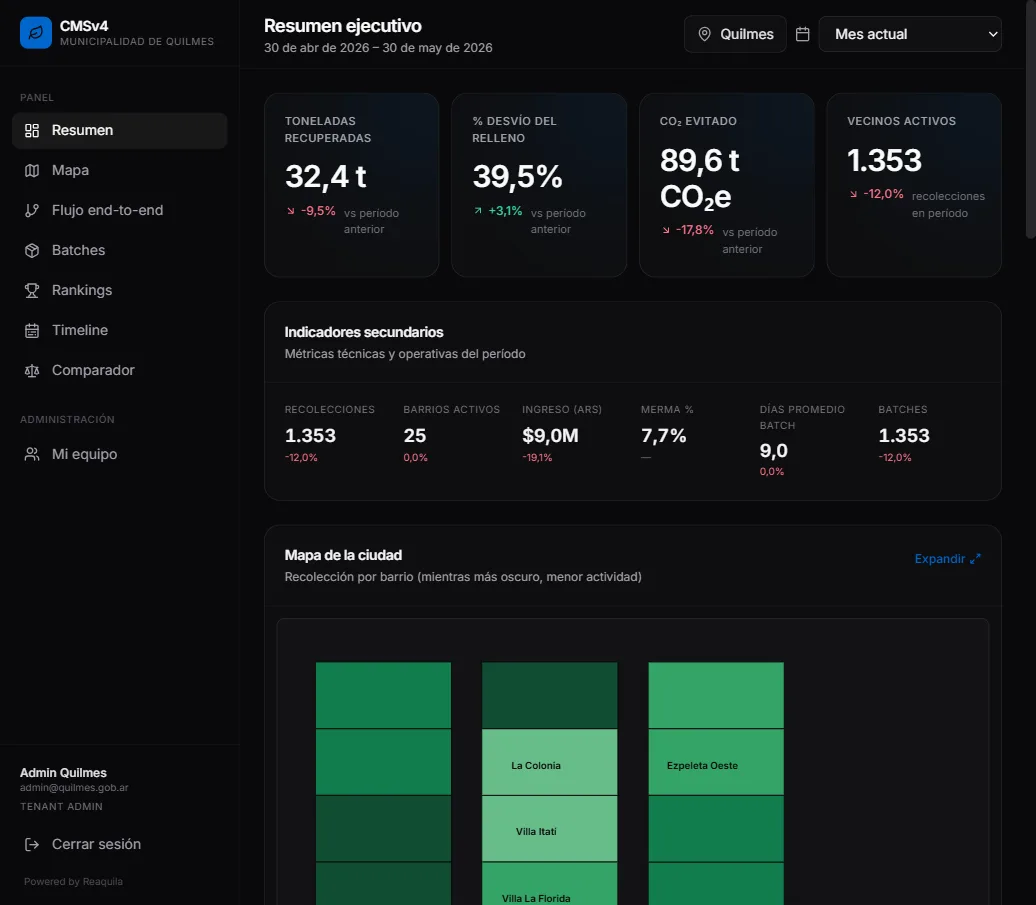
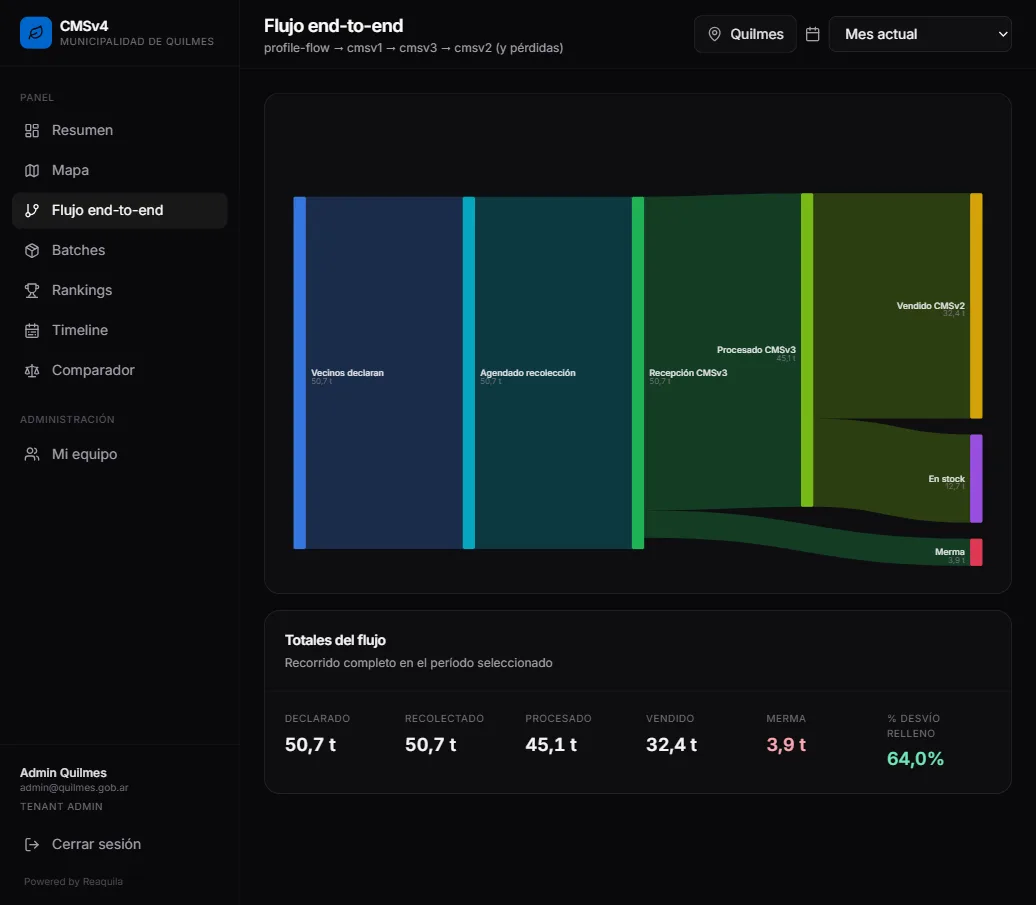
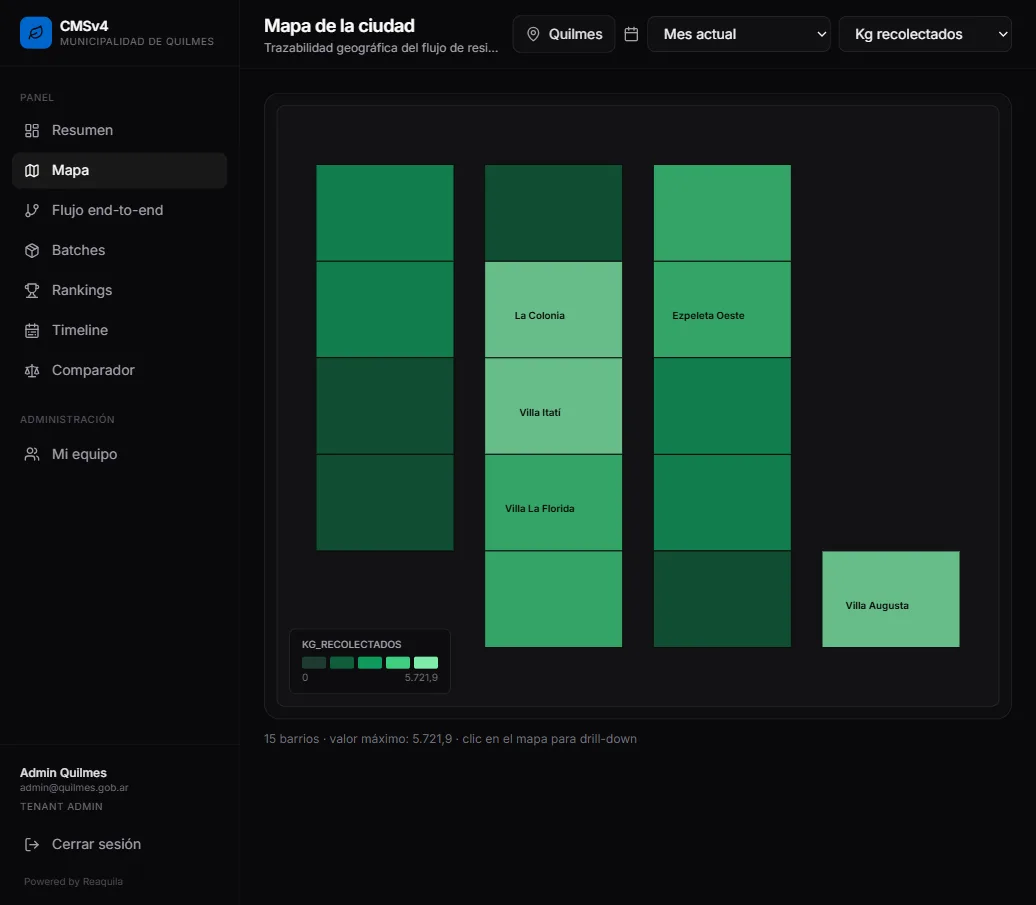
The full platform
Eleven products covering the full cycle of urban recycling: from the resident who sorts to the official who reports, passing through routes, plants, co-ops and the sale of material to industry.
Today your city's recycling has no dashboard: it has scattered spreadsheets.
End-to-end observation dashboard: tonnes recovered, landfill-diversion %, CO₂ avoided and active residents, with a neighborhood map, batch-level traceability and Excel/CSV export. Read-only, multi-agency, with roles for press and city council. Complies with habeas data (Law 25.326).
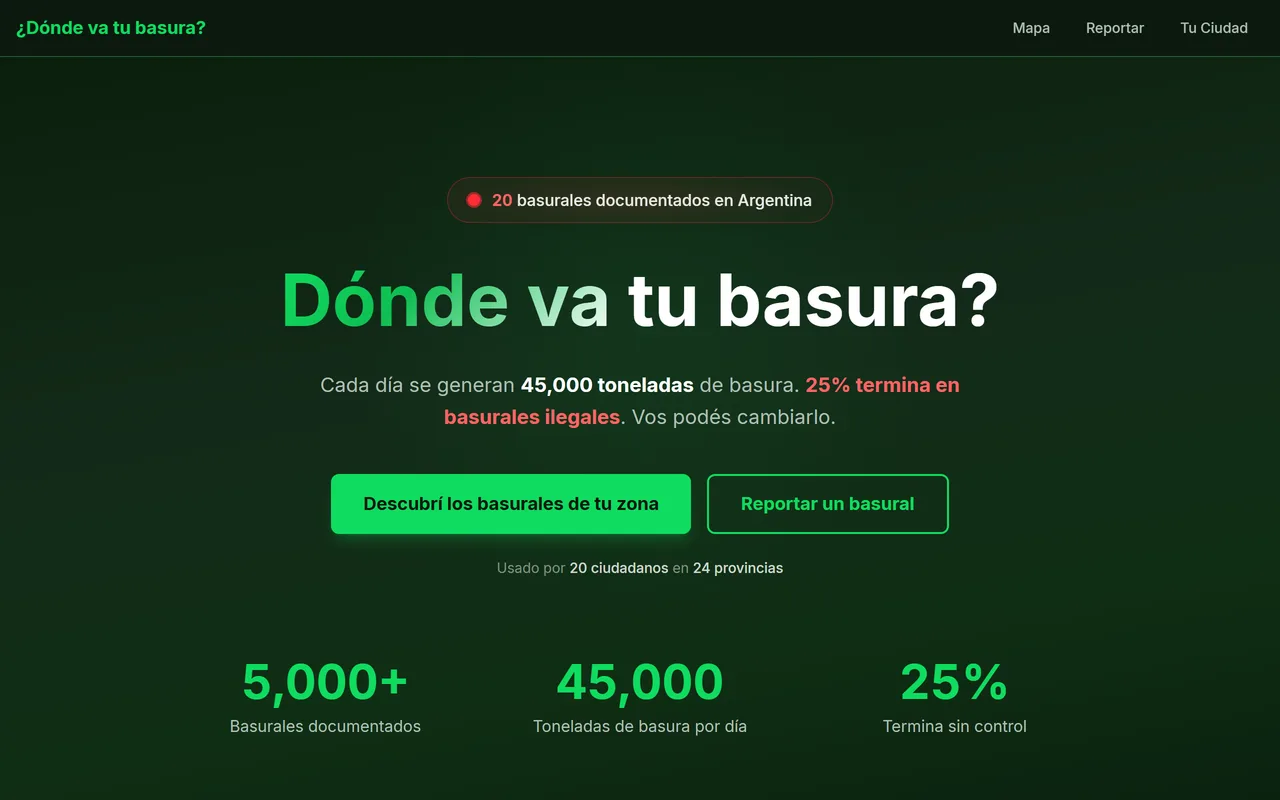
Illegal dumps show up in the newspapers before they show up in your reports.
Public map of open-air dumps with status tracking. The municipality verifies reports, flags sites under remediation or already cleaned up, and documents the progress of its GIRSU plan with georeferenced evidence.
Every request for reports is answered by hand, system by system.
Documented REST API (OpenAPI) to integrate recycling data with provincial systems, open-data portals or the agency’s own dashboards. Ready for AI agents as well.
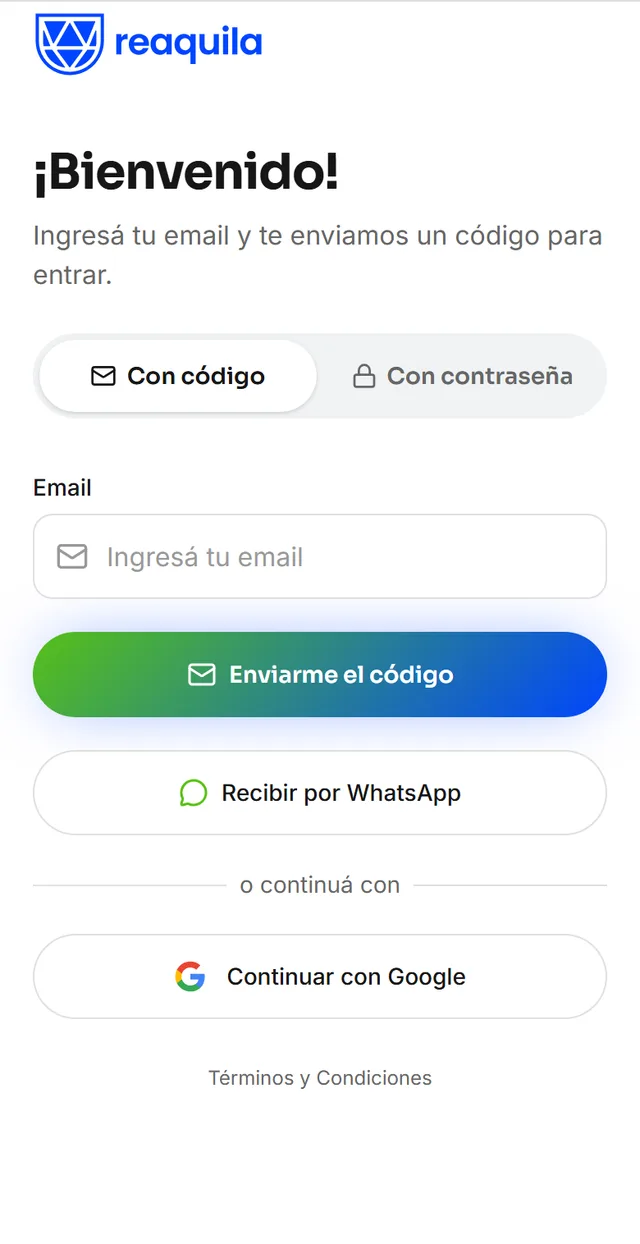
Citizen engagement burns out with each campaign: there is no permanent channel.
Residents request a pickup of their recyclables in seconds, track collection live and earn rewards for sorting. Every pickup feeds the city’s traceability.
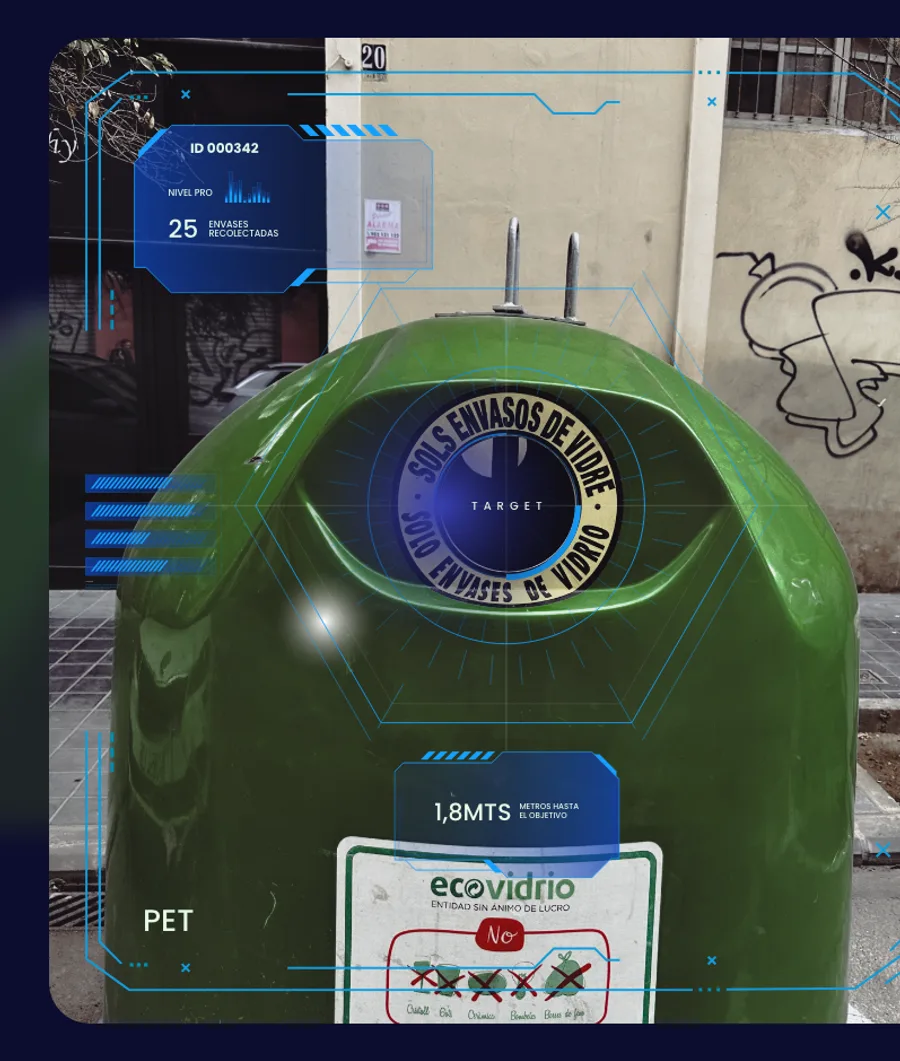
Drop-off points record neither what they receive nor how much.
Smart drop-off stations in neighborhoods and shops: they identify material by category, weigh, record and credit rewards. Every drop-off point starts generating data.
Residents ask on WhatsApp and no one answers.
Official WhatsApp channel with a bot plus human agents: sorting questions, pickup scheduling and complaints, on the channel residents already use every day.
Collection routes are built out of habit, not data.
Differentiated collection routes optimized with real demand data, with live tracking of every run and per-zone metrics to reallocate resources.
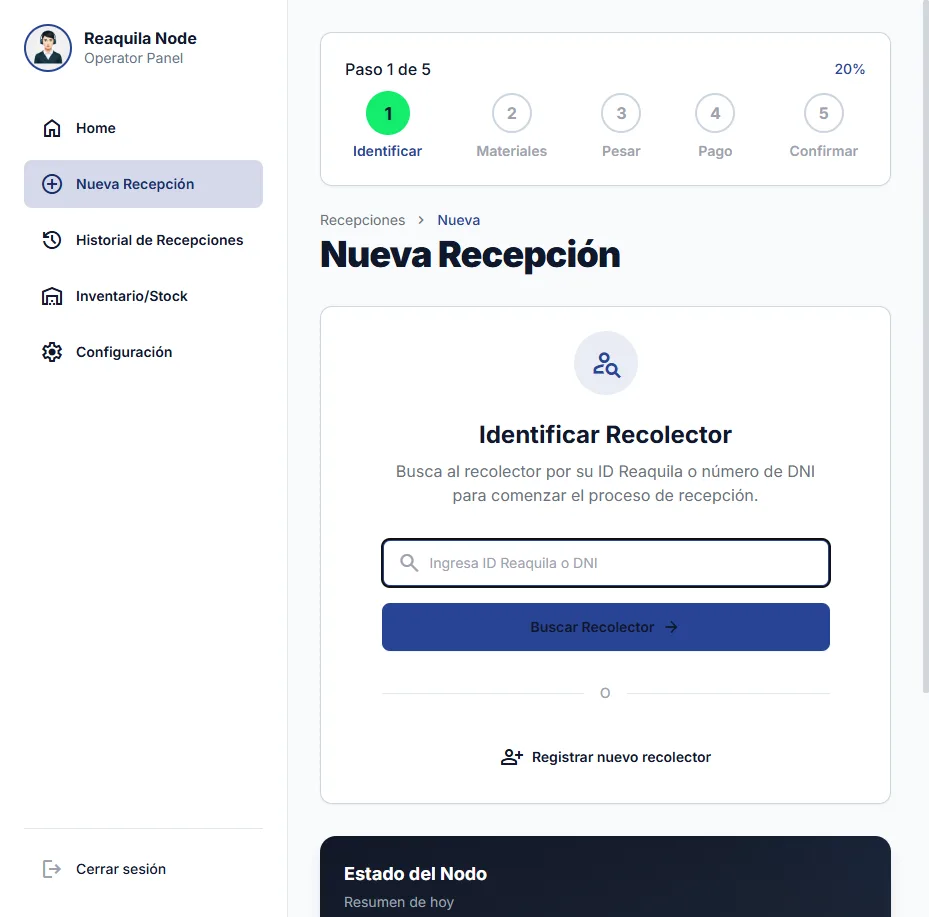
The municipal recycling plant is still keeping records on paper.
Management system for recycling plants, warehouses and co-ops: intake with weighing, inventory, baling, sales and payments. Every kilo that comes in is traced from its origin.
Coordinating requests, incidents and communications takes a whole team.
Central operations console: pickup requests, incidents, users, materials, orders and communications, all in one place and connected to the dashboard.
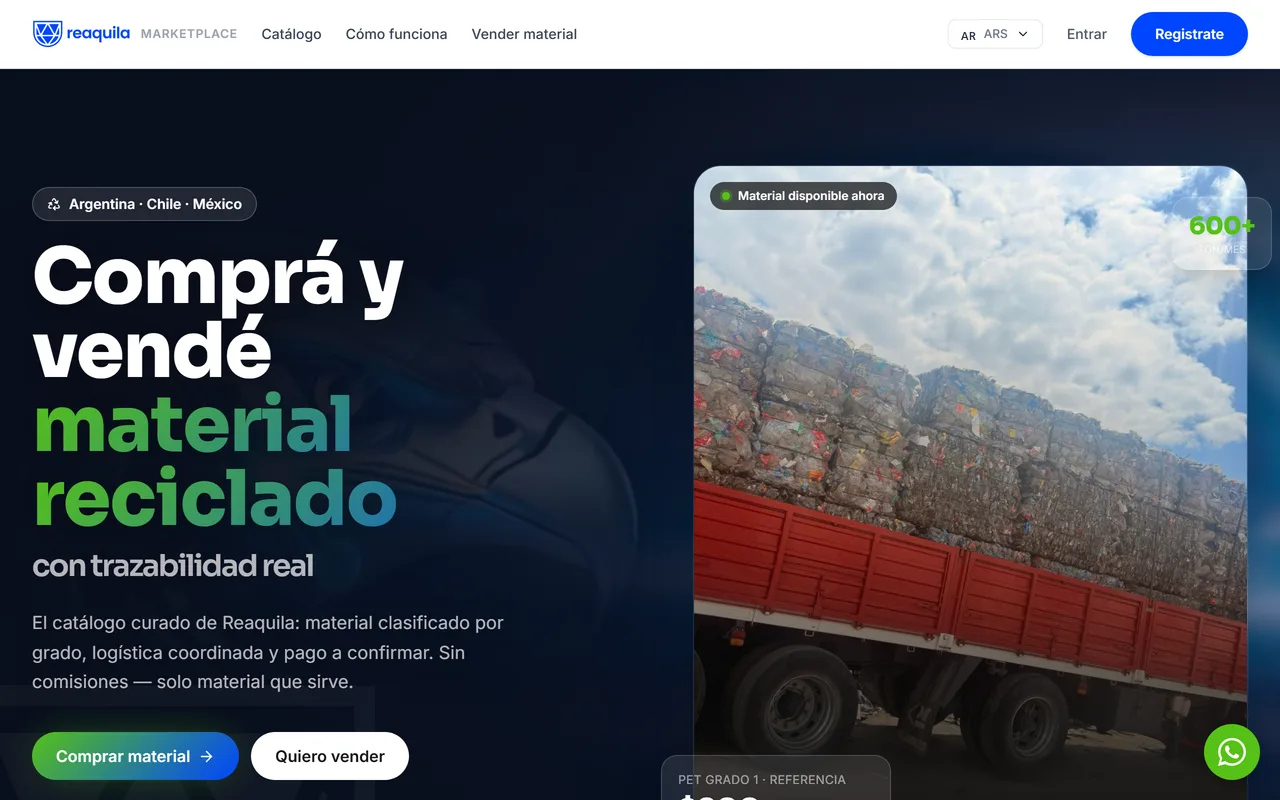
Recovered material is sold off cheap with no record and no traceability.
B2B marketplace where the material recovered by the city is sold to industry with full traceability: a better price for co-ops and a documented close of the loop.
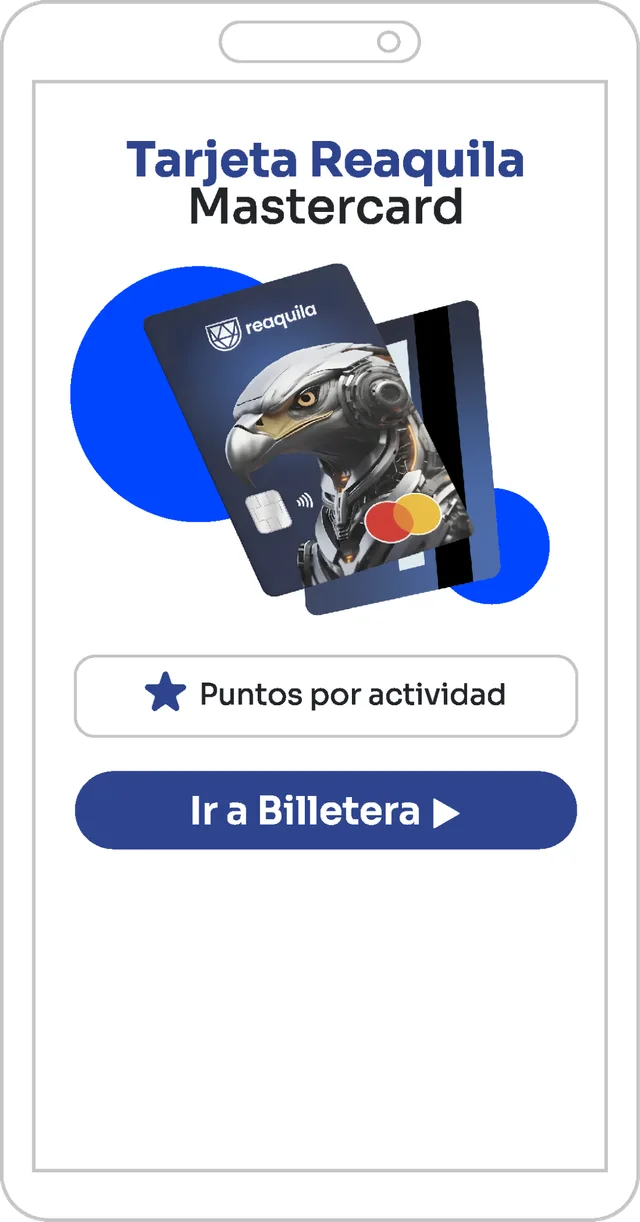
Collectors and co-ops get paid late, in cash and with no track record.
Digital wallet with a Mastercard card for collectors and co-ops: instant payments, income history and real financial inclusion for the most fragile link in the loop.
The screenshots show the platform’s real applications; the dashboard data corresponds to a demonstration environment.
Local proof
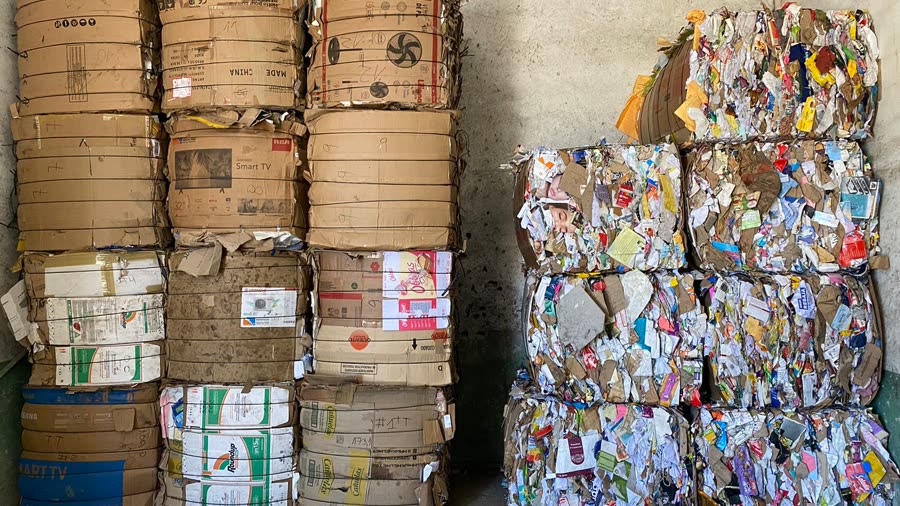
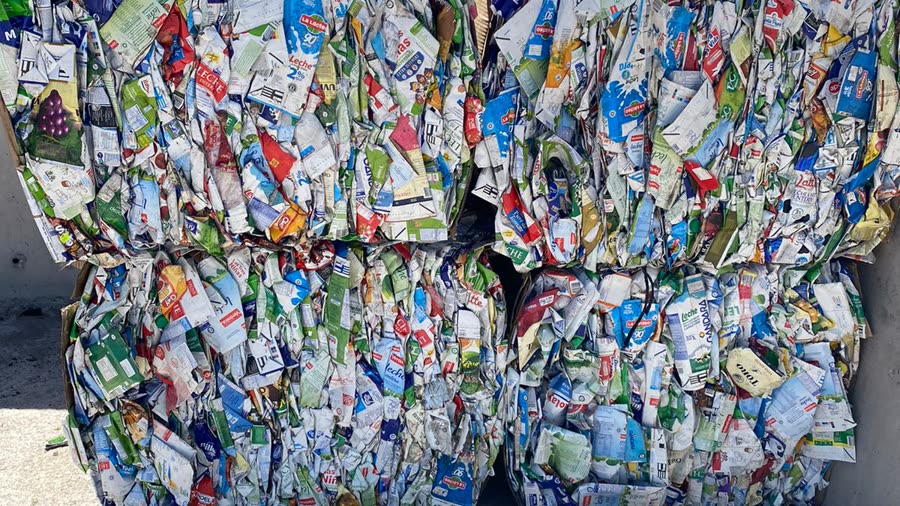
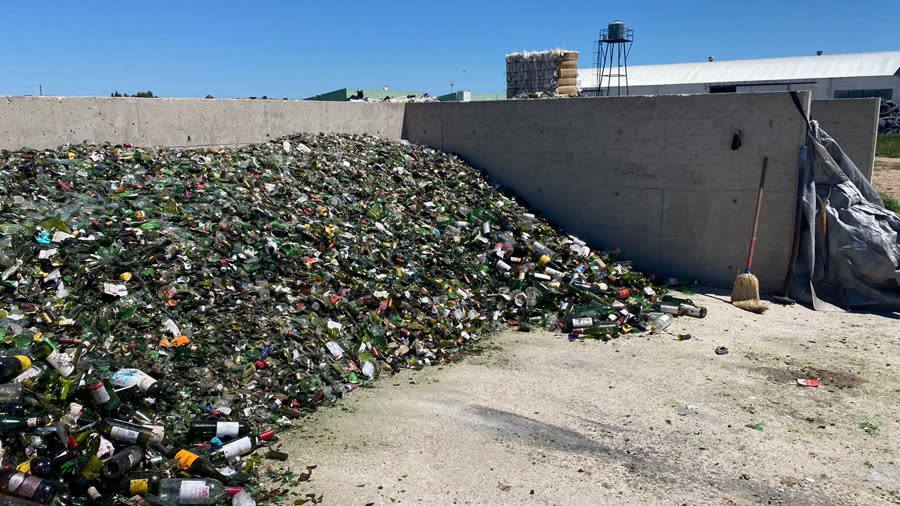
Bahía already has differentiated routes, the General Cerri Ecoplanta, Ecopuntos and the Bahía Recicla program — now Bahía Limpia. Collection is already happening; what’s missing is measuring, tracing and proving.
The local waste ordinances (19374, 20319 and 12672) and the municipality’s GIRSU manual set recovery targets: the platform turns those targets into live metrics per route, per Ecopunto and per bale leaving the Ecoplanta. Reaquila was born here and knows this operation first-hand — the same model applies to any Buenos Aires municipality.
Trust
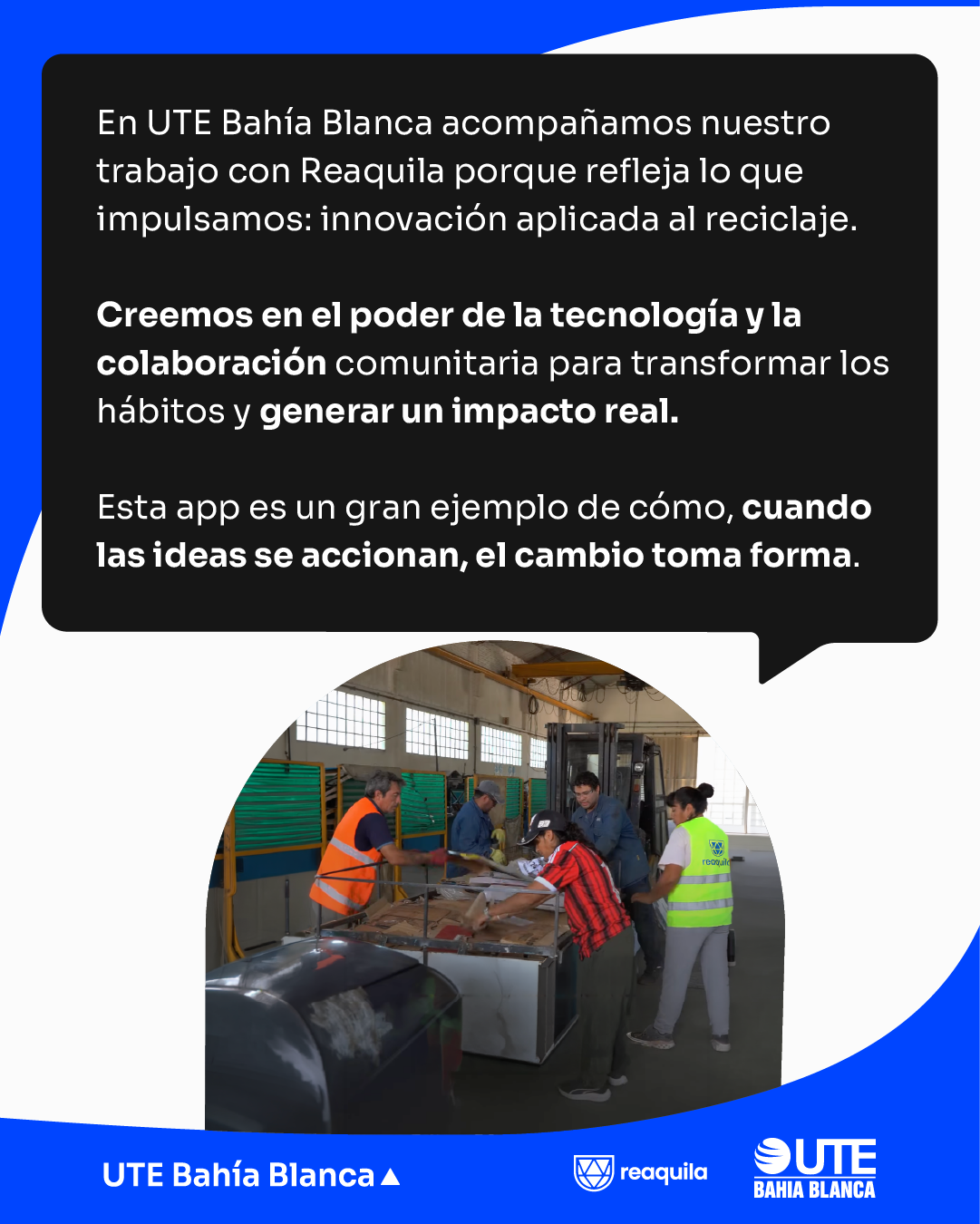
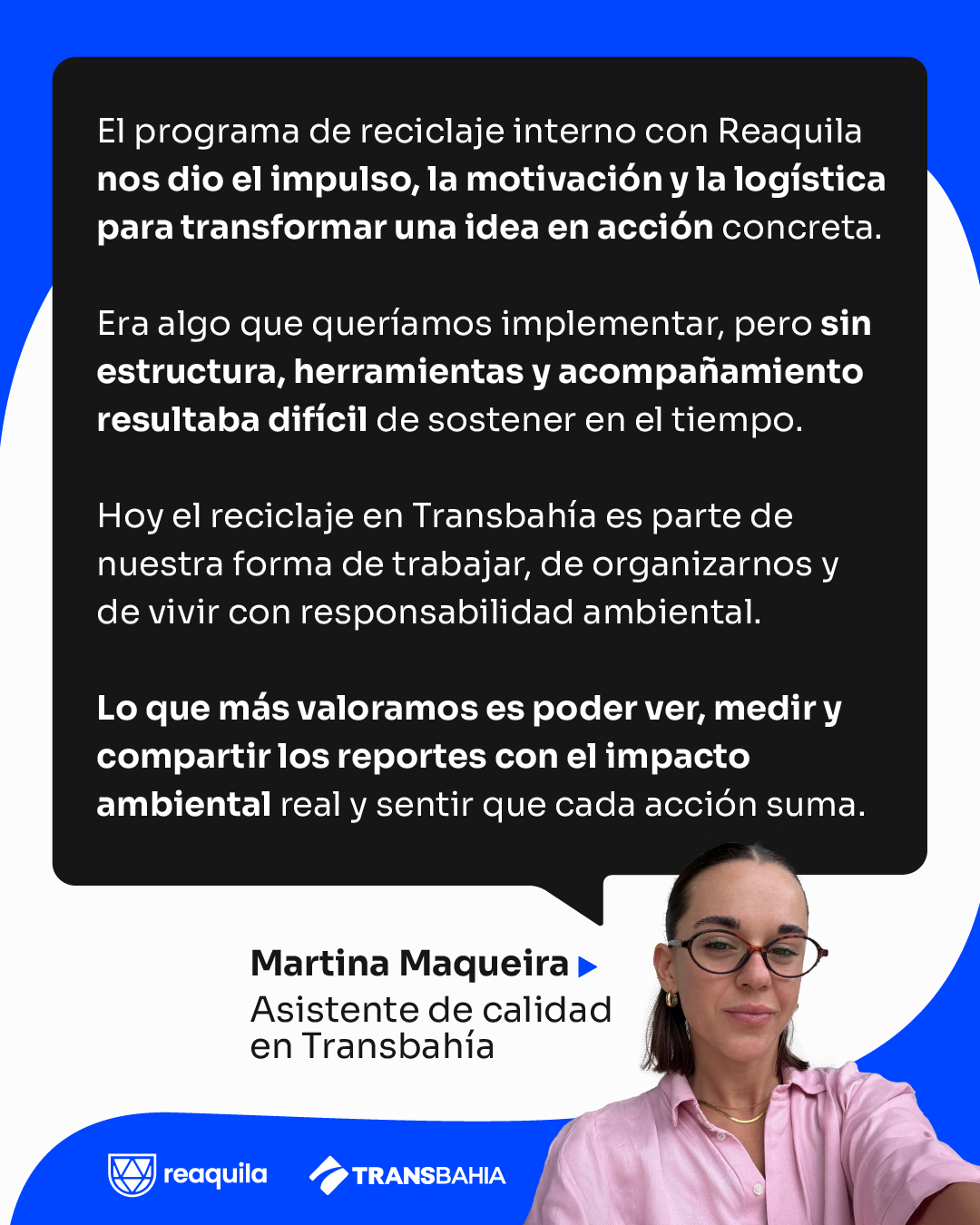
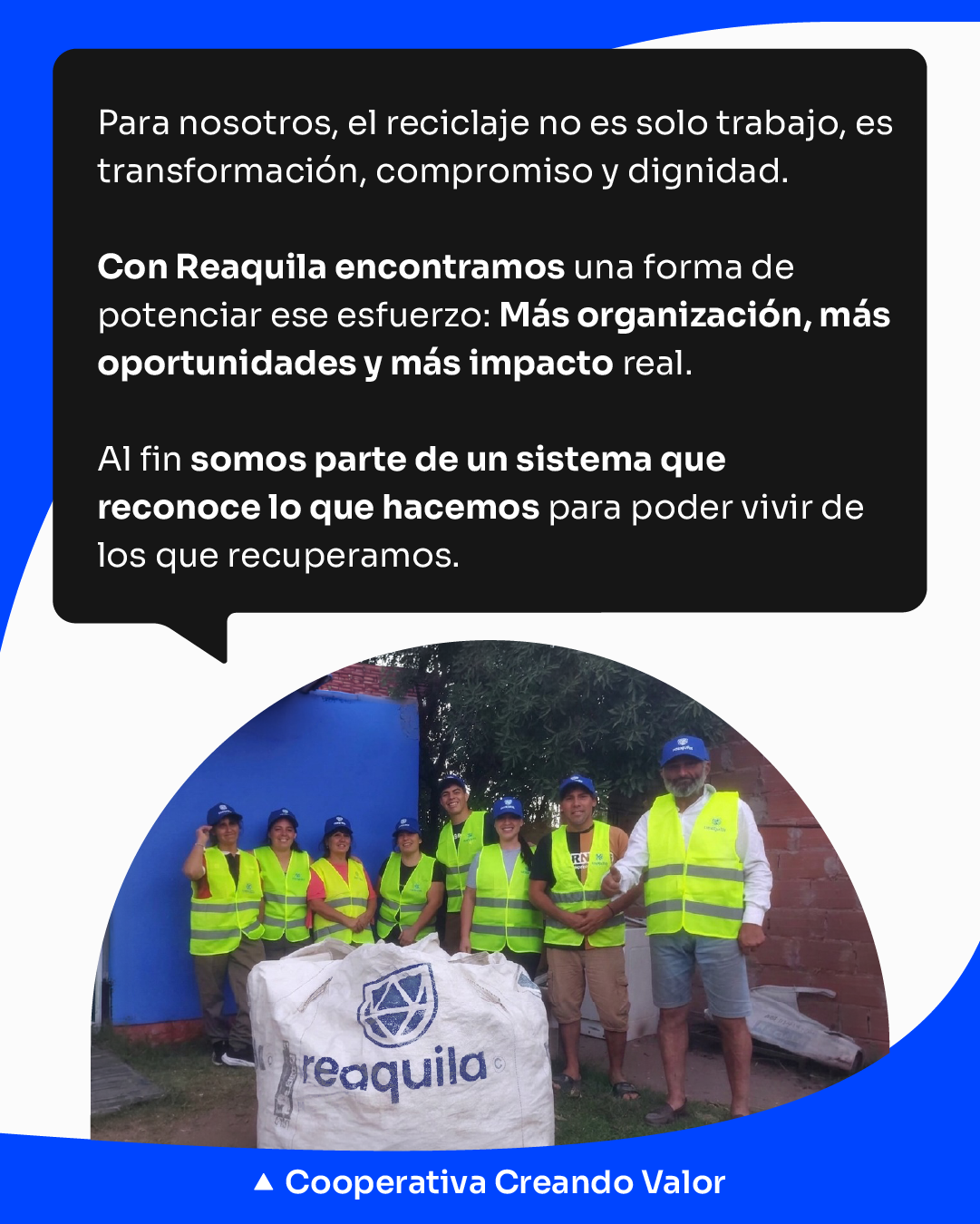
Brands, industry and local operators already use Reaquila traceability every day.









No risk
From the first contact to a working dashboard, without restructuring your operation or committing budget up front.
A 45-minute technical meeting, no strings attached. We show you the dashboard in action and map your current operation: routes, plants, co-ops and applicable regulations.
We start with a simple agreement on one zone or one material stream. No large tender up front: measurable results before scaling.
SAPEM, co-ops, recycling plants and existing systems connect to the platform. No one changes how they work on day one: first we digitize, then we optimize.
From the first month: auditable metrics, batch-level traceability and reports aligned with GIRSU and provincial regulations, ready for management reports and the press.
Each agreement is tailored to the scope: population size, modules and level of integration with the existing operation. The demo and the initial assessment are free, and the pilot is sized to be affordable before scaling.
Depending on the amount and local regulations, contracting can be done through a collaboration agreement, direct contracting or a public tender. We support the assembly of the file with whatever technical documentation the legal team needs.
The agency does. You can export everything to Excel/CSV at any time, and data handling complies with Law 25.326 on personal-data protection: the dashboard exposes no personal information about residents and locations are published with reduced precision.
Yes. Reaquila digitizes the existing operation, it doesn’t replace it. Plants and co-ops use the management system to record what they already do, and that data feeds the municipality’s dashboard.
It creates the framework for non-special industrial waste (RINE): provincial registries of generators and operators, digital transport manifests, annual sworn declarations and treatment certificates within 30 days. It has been in force since April 17, 2026, and Reaquila’s digital traceability produces exactly that kind of evidence.
The dashboard with the digitized operation is up and running during the pilot, in weeks rather than years. Integration with the agency’s own systems is planned in stages, case by case.
Yes. The dashboard is fed by the operation: routes, plants and co-ops record material even if no resident uses the app. The app and the EcoStations add citizen engagement and more data, but they are not a requirement.
The operation itself, just by doing what it already does: the collector confirms the pickup, the plant weighs on intake, the co-op records the sale. The official enters nothing: they consult, export and communicate.
We reply within 48 business hours with a demo proposal using your city’s data. Free and with no commitment.